



Have Questions?
-
Genuine Parts
Guaranteed Authentic
-
Modification Specialists
Call for assistance
-
Mod Now, Pay Later
Financing Available
-
Save On Delivery
Free shipping on most orders over $199
AMS Performance Cold Air Intake System - Ford Raptor / F-150 2.7L & 3.5L EcoBoost 2021+
 Lease for as low as $/week
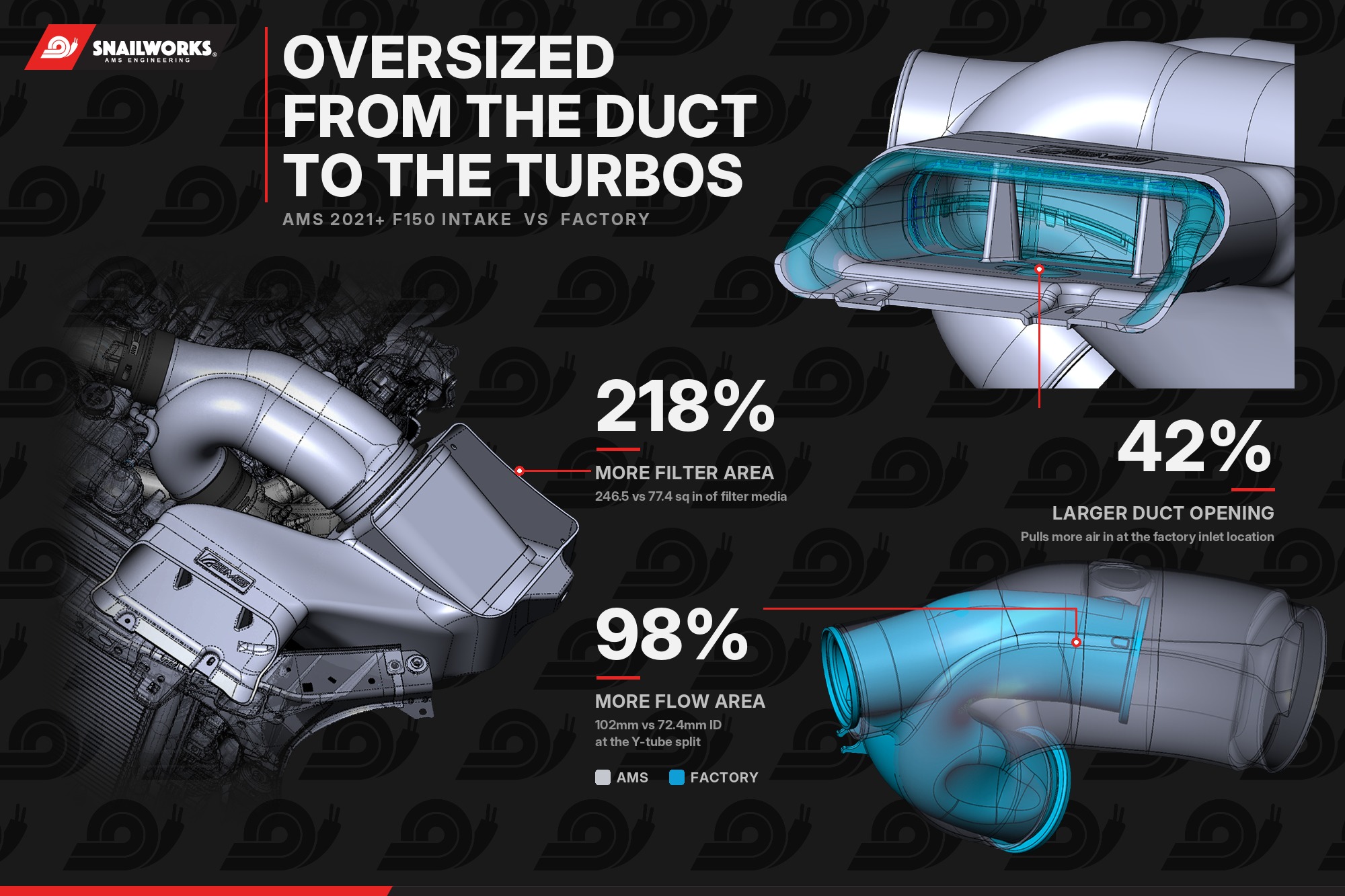
Ford feeds the 2021+ F-150’s twin turbos through a Y-tube in the intake that necks down to 72.4mm right where it splits, behind a panel filter barely larger than a sheet of paper. The AMS Performance 2021+ Ford F150 Intake replaces both with a rotomolded XLPE airbox and tube engineered around the airflow, not around whatever space was left under the hood. The AMS Y-tube opens that choke point to 102mm ID for 98% more flow area, feeds it through a duct opening 42% larger than stock, and filters it through 218% more frontal area than the factory panel. The open airbox keeps the turbos from being capped at the grille duct, and it turns up every turbo and bypass valve sound the factory intake was hiding. Flow bench tested at 91% less restriction than the factory intake and proven on the dyno with +17 whp at 4,900 rpm and +8.6 whp average across the rev range, no tune required. It bolts in with no cutting or trimming, pairs with the AMS F150 Turbo Inlet Tubes for a straight-through path from the grille to the compressor wheels, and one part number fits every 2021+ F-150 2.7L EcoBoost, 3.5L EcoBoost, and Raptor.
-
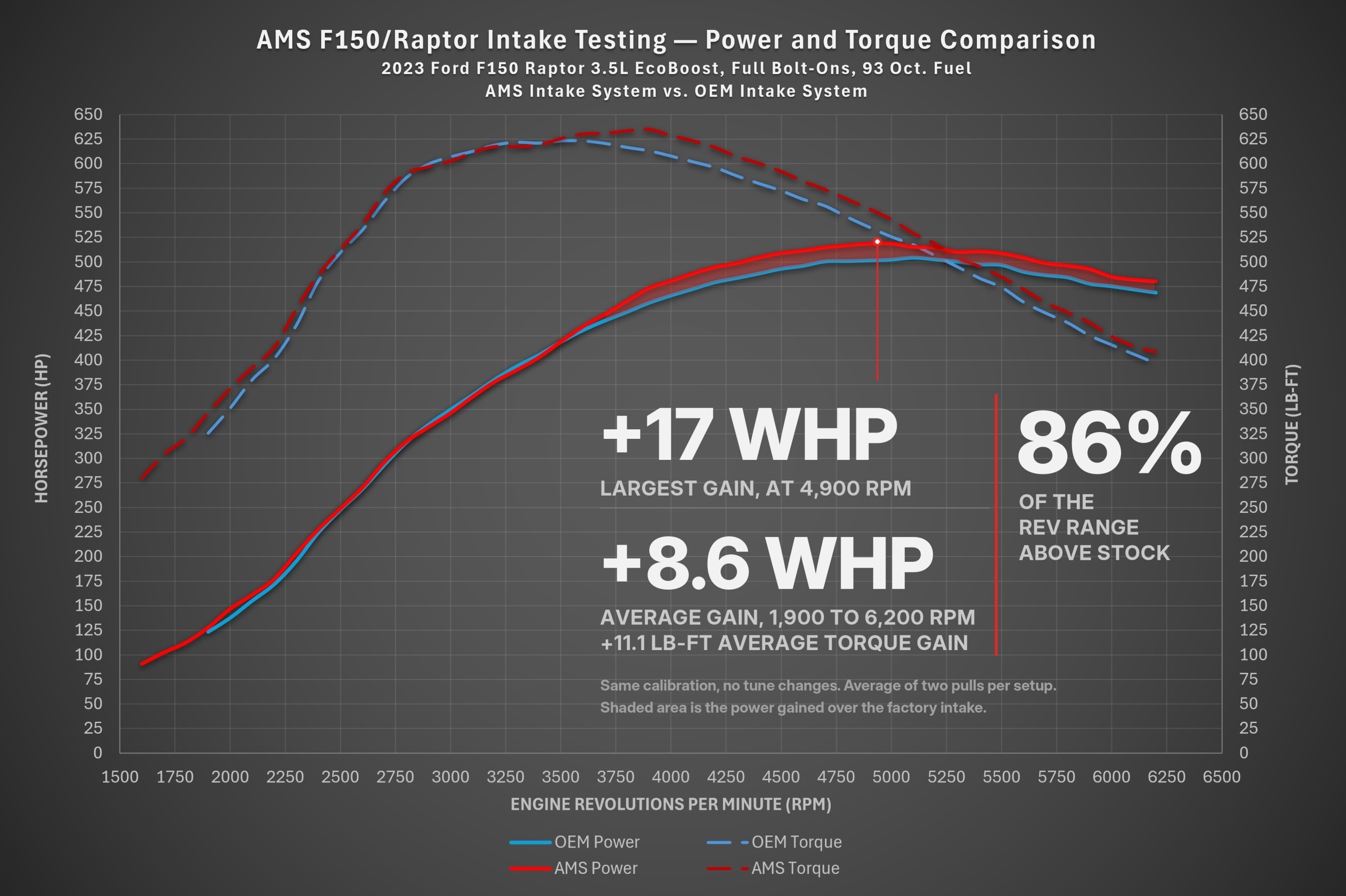
+17 whp peak and +8.6 whp average over stock on the same Stage 2 calibration
-
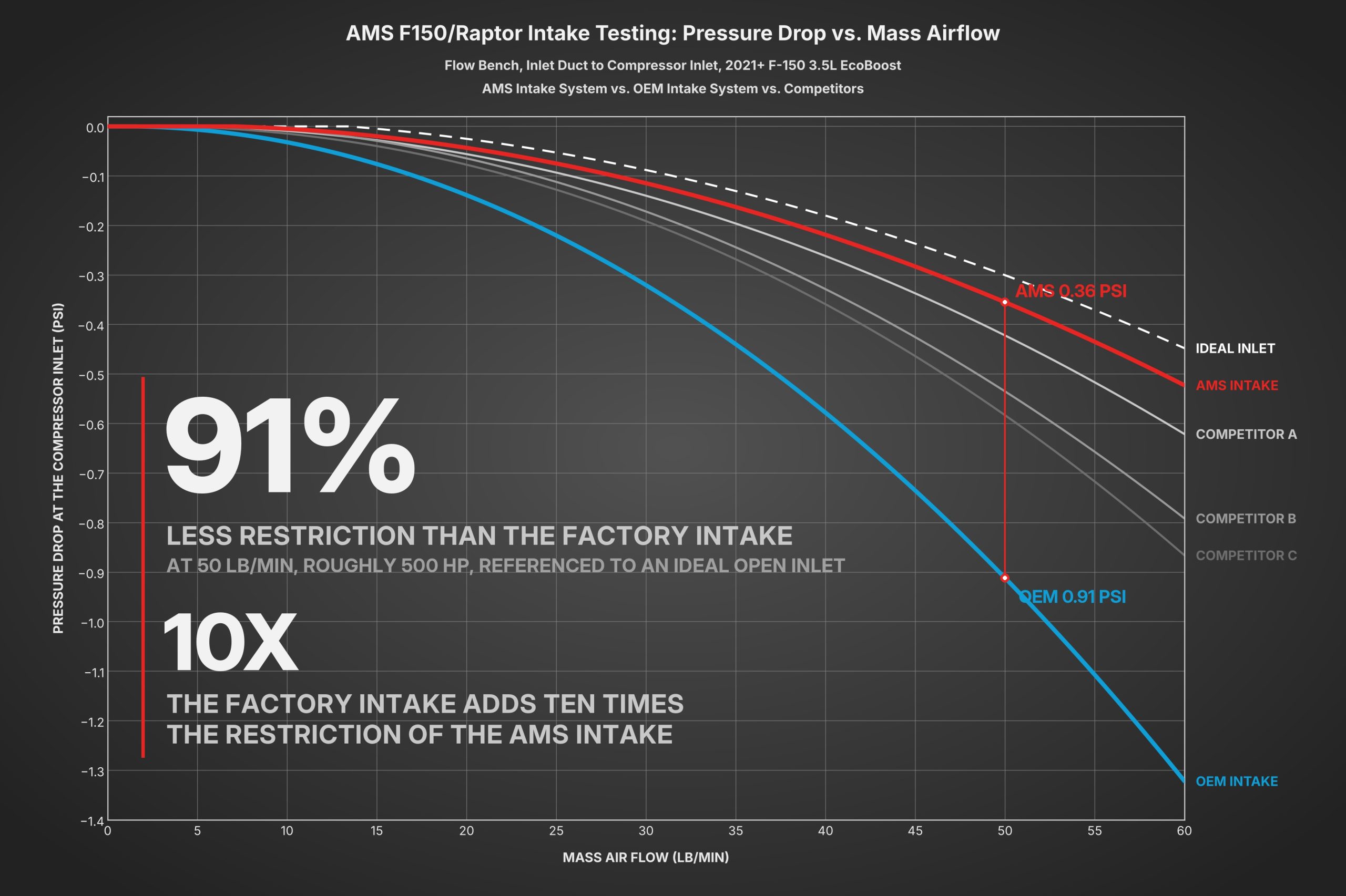
91% less intake restriction than stock on the flow bench, referenced to an ideal open inlet
-
Open airbox lets you hear every bit of turbo spool and bypass valve release the factory lid buried
-
98% more flow area at the Y-tube restriction, 102mm ID vs 72.4mm OEM
-
Massively enlarged rotomolded XLPE airbox and tube feed the filter far more air than the factory box ever could
-
218% more filter frontal area than the factory panel filter
-
42% larger duct opening pulls more fresh air in from the factory inlet location
Engineered to Win
Most companies in this space start with a tape measure. They find the biggest filter that fits the corner, run a tube to the turbos, and call it a cold air intake. The SnailWorks Engineering Team started somewhere different: with a CAD model of the entire factory intake tract, from the grille duct to the compressor inlets, and a question about where Ford actually left power on the table. The answer was everywhere. The duct opening into the airbox is undersized, the panel filter is barely larger than a sheet of paper, and the Y-tube necks down to 72.4mm at the exact point where it splits toward the two turbochargers. The AMS 2021+ F150 Intake fixes all three. The duct opening grows by 42%, the filter brings 246.5 square inches of frontal area against 77.42 for the factory panel, and the AMS Y-tube holds 102mm ID through the split for 98% more flow area at the tightest point in the system. Less restriction ahead of the compressor means less pressure ratio the turbos have to make up before they make any boost. Most companies design an intake to fit the space Ford left behind. AMS engineers it to dominate that space.
Open by Design
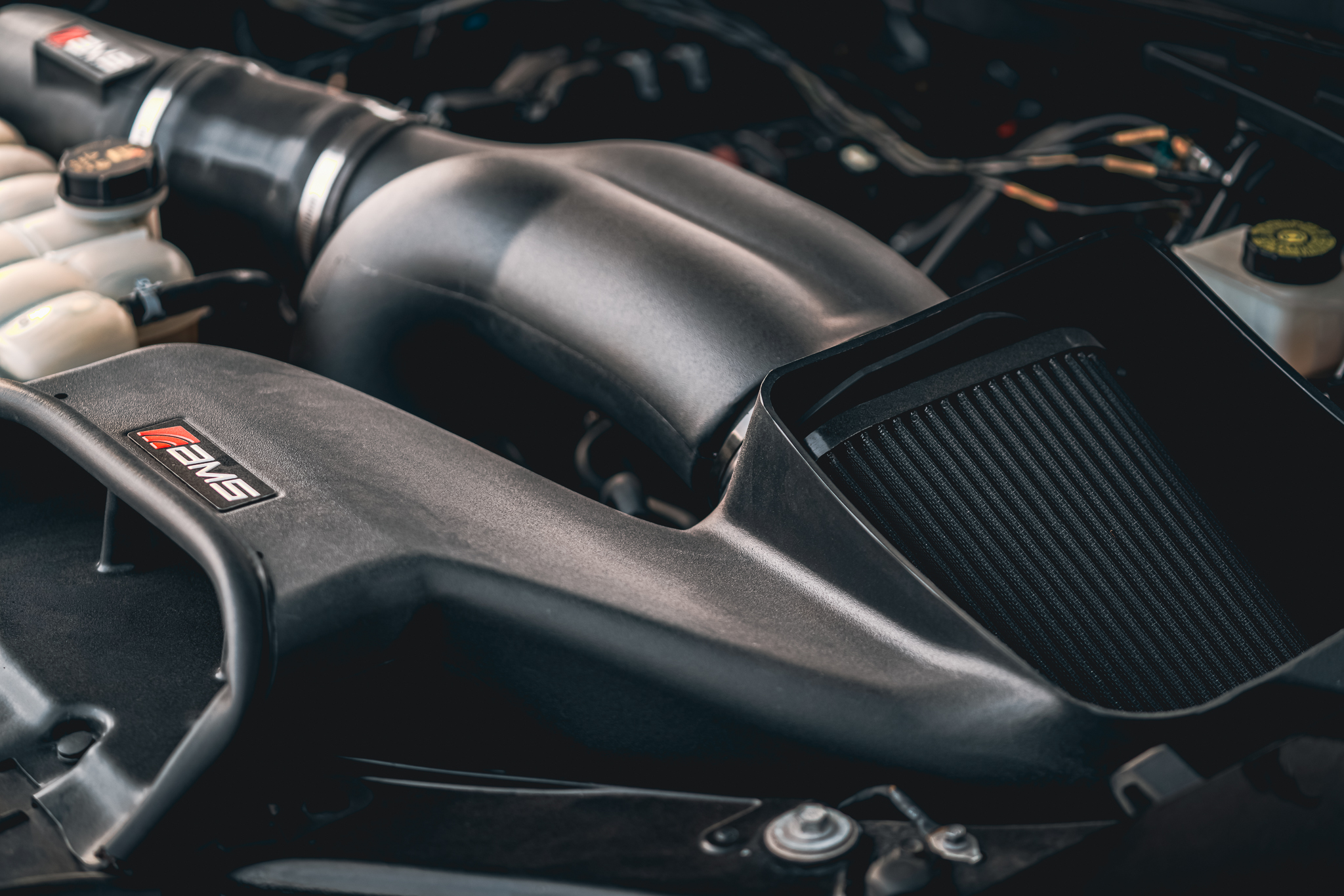
The AMS 2021+ F150 Intake runs an open airbox on purpose. The factory box is sealed, so every bit of air the EcoBoost breathes has to squeeze through the single duct behind the grille, and at full load that duct is the ceiling. The AMS box pulls through a duct opening 42% larger than stock and then keeps going, drawing from the open side as well, so the turbochargers are never capped by one inlet. Critics will point at underhood air. The SnailWorks Engineering Team looked at the same tradeoff and sized the whole system around total airflow, because on a twin turbo truck the restriction ahead of the compressor costs more than a few degrees of inlet temperature ever will. The other thing an open box gives you is sound. Turbo spool, bypass valve flutter, every bit of induction noise Ford buried under a plastic lid comes through clean. Both the airbox and the tube are rotomolded from XLPE, a cross-linked polyethylene that shrugs off fuel and oil and will not crack from engine vibration the way thinner injection-molded parts can, finished in black texture with an embossed AMS logo for an OEM-plus look. Inside the box, the filter uses dry media, so there’s no oil to service or foul a sensor, and it’s washable and reusable for the life of the truck. Installation is just as clean. No MAF sensor means no scaling and no ECU recalibration are necessary, the factory intake air temperature sensor transfers directly into the AMS tube, and nothing gets cut or trimmed. Two sets of silicone couplers come in the box: one sized for the stock diameter inlet tubes, factory or aftermarket, and one sized for the larger AMS F150 Turbo Inlet Tubes, which deletes the small factory-sized couplers and makes a straight-through connection from the airbox to the turbochargers at full diameter. Basic hand tools, one afternoon, and the truck sounds the way it should have from the factory.
Flow Bench Tested
Claims without data are just marketing. The SnailWorks Engineering Team ran the AMS F150 EcoBoost Intake, the factory airbox and Y-tube, and three of the best-selling aftermarket intakes for this truck back to back on the flow bench, measuring pressure drop from the inlet duct to the compressor inlets across the full airflow range of the 3.5L EcoBoost. We make the comparison at 50 lb/min of airflow, roughly 500 horsepower, which is where most of these trucks live once they are modified and tuned. The reference point is an ideal open inlet, a bare bellmouth with no duct and no filter, because that is the floor no intake can beat: even a perfect inlet shows 0.30 psi at 50 lb/min just from pulling that much air into the compressor. Everything above that line is restriction the intake itself adds. The factory intake adds 0.61 psi on top of it. The AMS intake adds 0.06 psi, 91% less restriction. Put another way, the factory intake adds ten times the restriction of the AMS intake. Every competitor tested landed between the two, and the AMS intake adds 55 to 81% less restriction than any of them. Restriction ahead of the compressor grows faster than airflow does, so the harder the truck is pushed, the more a free flowing intake is worth.
Data Driven Design: On-Vehicle Testing
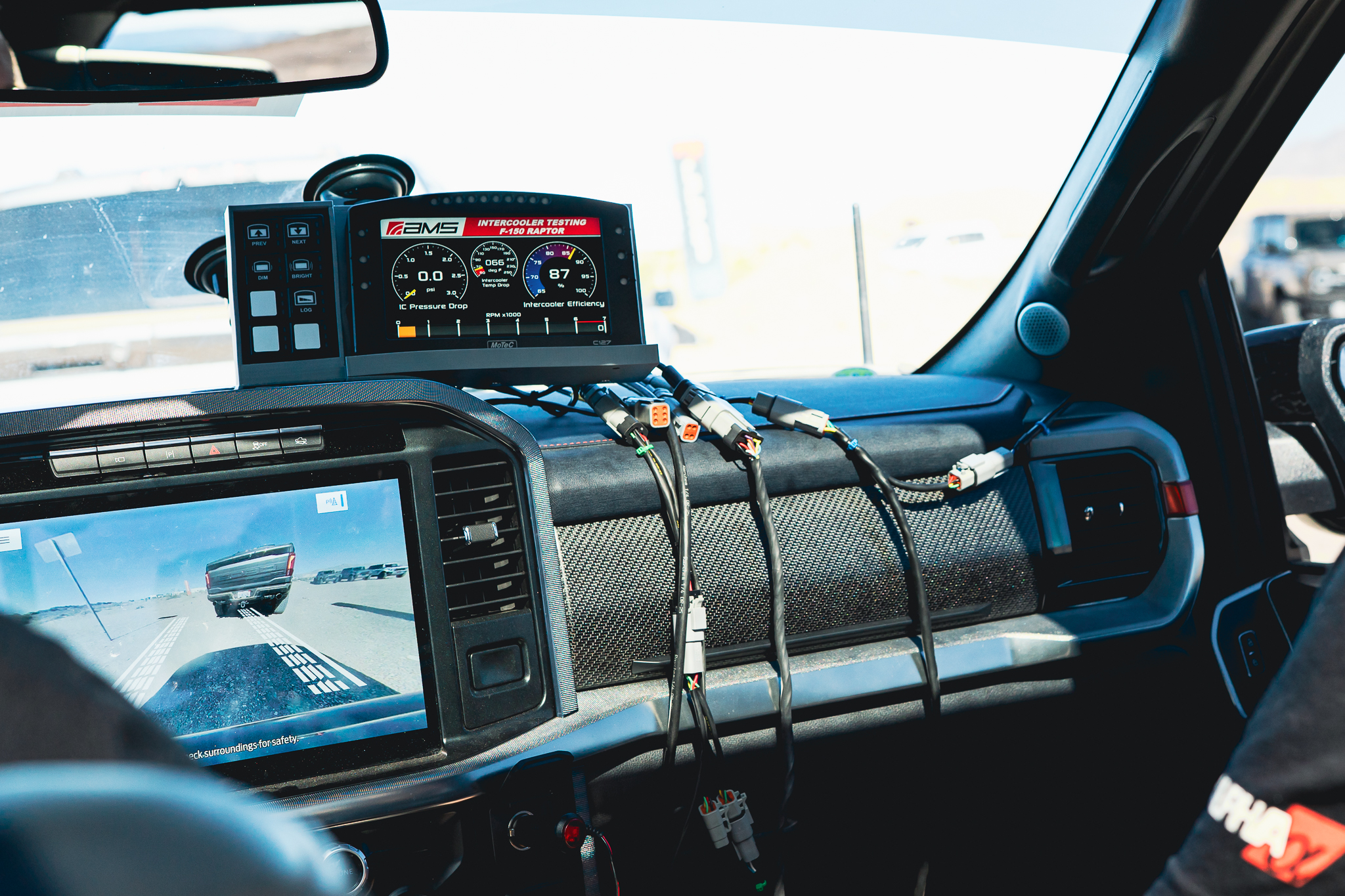
Bench numbers only matter if they show up on the truck. Our 2021+ Raptor development vehicle has run everything we build for this platform through the real world, from frozen winters around the Great Lakes to the dust and heat of the Arizona desert, on the road and in off-road desert racing at Raptor Rally. It carries a MoTeC dash data logger and a 19-sensor array that monitors critical engine and turbocharger parameters in real time, and the AMS F150 Intake ran that same program through on-road data logging and on the AMS Dynojet AWD dyno. Every pull used the same AMS Stage 2 calibration on 93 octane, with pressure sensors at both compressor inlets and every result taken as the average of two runs, so the intake was the only variable in the result. The pressure sensors at the compressor inlets saw the factory restriction fall away exactly as the flow bench said it would, and what the turbochargers did with that air is on the dyno chart below.
The Data Speaks for Itself
On the same calibration with no tuning changes, the Raptor picked up 17 whp at 4,900 rpm and averaged 8.6 whp and 11.1 lb-ft more than stock from 1,900 to 6,200 rpm, running above the factory intake across 86% of the rev range. Peak power moved from 503.5 to 520.3 whp, and the gain is not a spike at redline. It shows up in the middle of the tach where the truck actually lives, towing, passing, and pulling out of a corner on the trail, and it holds through the top of the pull.
The reason is on the pressure trace, logged during the same dyno runs by the MoTeC sensors at the compressor inlets. At the top of the pull the factory intake is costing the turbochargers nearly a full psi of pressure, 0.99 psi, before they make any boost. The AMS F150 Intake cuts that to 0.37 psi, and the gap between the two traces holds across the entire pull. Every psi lost ahead of the compressor is pressure ratio the turbochargers have to make up before they make any boost, so a freer flowing intake lets them hit the same manifold pressure with less work, lower shaft speed, and less heat going into the charge air. Two separate instruments measured the same pull: the pressure sensors saw the restriction drop, and the Dynojet dynamometer saw the power come up, with the gains landing precisely where the restriction was falling away.
That is a bolt-on gain from letting the turbochargers breathe, and it comes before an ECU recalibration built around the freer flow unlocks the rest of what the AMS Raptor and F150 intake is capable of. A tune that knows the restriction is gone can lean on the turbos harder and open up more of the headroom the AMS Performance 2021+ F150 EcoBoost intake gives it.
Product Notes
- Includes two sets of silicone hoses: one for stock diameter inlet tubes (OEM or other aftermarket brands) and one for the larger AMS Performance F150 Turbo Inlet Tubes.
- Does not fit PowerBoost 3.5L EcoBoost models due to hybrid system coolant reservoir interference.
- Filter Care: The AMS dry media filter can be restored to near new performance without washing. For routine maintenance, remove the filter and blow compressed air at 30 to 40 psi through the media from the inside out, which restores approximately 90% of new filter airflow. For a deep cleaning after exposure to extreme environments, which restores approximately 98% of new filter airflow, apply a biodegradable cleaner such as Simple Green or a mild shop degreaser, either by soaking the filter or spraying the media directly, and allow the cleaner to loosen trapped particulate before rinsing thoroughly with clean water. Remove residual water by shaking the filter or applying compressed air from the inside out, then allow the filter to air dry completely for 48 hours before reinstalling. Do not apply filter oil.
Returns may be accepted within 14 days of purchase pending Return Merchandise Authorization (RMA). No returns or cancellations on special order items. All returns will be charged a 20% restocking fee, no exceptions.
To be eligible for a return, your item must be unused and in the same condition that you received it. It must also be in the original packaging. Item must be able to be resold as new.
Several types of goods are exempt from being returned. Hazardous materials, fluids, greases, chemicals, and clothing are not able to return.
Free shipping is available within the lower 48 states for most orders totaling $199 or more. A free shipping option will be available during checkout. This offer is for delivery address in the continental United States and excludes shipments going to Alaska, Hawaii, Military Boxes, and items that require freight shipping.
Processing Time
Patterson Performance stocks a large quantity of items at any given time. Some items may require drop shipping from one of our various distributors. In stock items will ship within 1-2 business days. If you're needing your product quickly, please contact us to verify product availability before placing your order. Orders requiring additional verification (security concerns, incorrect information, etc.) may need additional processing time. Estimated shipping dates are not guaranteed and are subject to change based on inventory levels and manufacturer lead times. Backordered items are shipped immediately once available.
Items ship daily, If the item you ordered is not in stock, a member of our team will contact you via email / phone.
Patterson Performance will only ship to an address that varies from your billing address if payment is made via Paypal or a financing partner.
Patterson Performance ships from multiple warehouses throughout the United States, and sometimes from manufacturers overseas.
You can simply contact us via email / telephone for a live inventory check
Find more information at www.P65Warnings.ca.gov.